• General
  • Sri Sri Ravi Shankar
  • Art Of Living
    • Guinness Records
  • Knowledge
  • Stories
  • About Me

Art of Living, Sri Sri Ravi Shankar and My Self!

Art of Living, Sri Sri Ravi Shankar and My Self!

Category Archives: Knowledge

Top 10 Brain damaging habits!

15 Tuesday Jan 2013

Posted by Aravind Venkatachalam in Knowledge

≈ Leave a comment

Tags

Bad habits, Brain, Brain Damaging Habits, Habits, health, Sri Sri

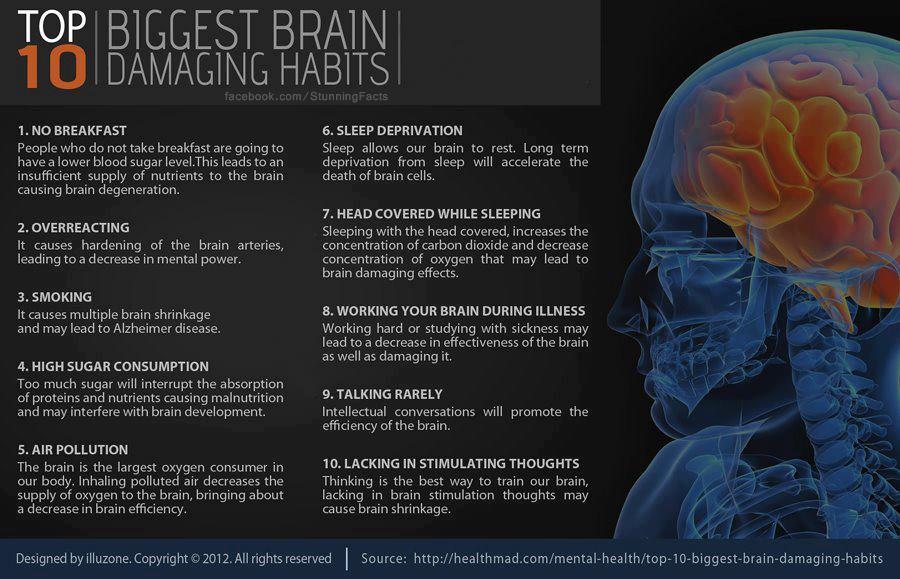
I had earlier written a post on bad habits and on how to deal with them. Sri Sri Ravi Shankar says that we can take the help of different emotions we go through to fight against bad habits. Here is a link to that post. http://wp.me/p2LxU9-2L. Here is an image giving the top 10 habits that we have that causes damage to the brain.

Habits that can damage the brain!

Habits that can damage the brain!

Some of the interesting things that fall into the top 10 are Not having breakfast, head covered while sleeping and talking rarely! Smoking is a no brainer :). Which of these do you have 🙂 ?!?

Share this:

  • Click to share on X (Opens in new window) X
  • Click to share on Facebook (Opens in new window) Facebook
  • Click to share on Pinterest (Opens in new window) Pinterest
  • Click to email a link to a friend (Opens in new window) Email
Like Loading...

Transmission of Knowledge

13 Thursday Dec 2012

Posted by Aravind Venkatachalam in Knowledge

≈ 6 Comments

Tags

Knowledge, Lakshmana, Mahabharata, Rama, Ramayana, Ravana, Transmission of Knowledge

One of our employee is leaving the company and we had to setup a lot of knowledge transfers sessions so that we could get all the knowledge that the employee would be parting off with. I could see my manager setting up long long meeting sessions with this employee to get it all. I was thinking if this is how it has been from the past until the present. What is that people want to give back before they leave? When I was reading stories from the hindu myths, the puranas, I saw a striking similarity between the two main spics in hinudism – The Mahabharat and The Ramayana.

In both the epics, after the war was over, there was a transmission of knowledge from the defeated to the one who was victorious! It was mostly the lessons that the defeated had learnt. No matter how strong the enmity was, there was always a parting of knowledge. It was really interesting to see this that I decided I would share it with you all. So here the story from the Ramayana first.

In the Ramayana, Ravana lies mortally wounded on the battlefield and themonkeys are celebrating their victory, when Rama turns to his brother, Lakshmana, and says, “While Ravana was a brute, he was also a great scholar.Go to him quickly and request him to share whatever knowledge he can.”  

The obedient Lakshmana rushes to Ravana’s side and whispers in his ears,“Demon king, all your life you have taken not given. Now the noble Rama gives you an opportunity to mend your ways. Share your vast wisdom. Do not let it die with you. For that you will be surely be blessed.” Ravana responds by simply turning away. An angry Lakshmana says “He is arrogant as he always is and is too proud to share anything”.

Rama looks at his brother and asks him softly, “Where did you stand while asking him for knowledge?” “Next to his head so that I hear what he had to say clearly.” Rama smiles places his bow on the ground and walks to where Ravana lies. Lakshmana watches in astonishment as his brother kneels at  Ravana’s feet.With palms joined, with extreme humility, Rama says, “Lord of Lanka, you abducted my wife, a terrible crime for which I have been forced to punish you. Now, you are no more my enemy. I see you now as you are known across the world, as the wise son of Rishi Vishrava. I bow to you and request you to share your wisdom with me. Please do that for if you die without doing so, all your wisdom will be lost forever to the world.”To Lakshmana surprise, Ravana opens his eyes and raises his arms to salute Rama, “If only I had more time as your teacher than as your enemy. Standing at my feet as a student should, unlike your rude younger brother, you are a worthy recipient of my knowledge. I have very little time so I cannot share much but let me tell you one important lesson I have learnt in my life. Things that are bad for  you seduce you easily; you run towards them impatiently. But things are actually good for you fail to attract you; you shun them creatively, finding powerful excuses to justify your procrastination. That is why I was impatient to abduct Sita but avoided meeting you. This is the wisdom of my life, Rama.”With these words, Ravana dies.

Now lets see what happens in the Mahabharata.

The war is over and the Kauravas are all dead. As the victorious Pandavas areabout to assume control of Hastinapur, Krishna advises them to talk to Bhisma,their grand uncle, who lies mortally, wounded on the battlefield. As a result of ablessing, death would elude him for some time. “Make him talk until his last breath. Ask him questions. He has a lot to tell,” says Krishna.Sure enough, when prompted, the dying Bhisma spends hours discussing various topics: history, geography, politics, economics, management, war,ethics, morality, sex, astronomy, metaphysics and spirituality. Bhisma’sdiscourse is captured in the Shanti Parva (discussions of peace) and AnushasanParva (discussions on discipline) that makes up a quarter of the Mahabharata. After listening to their grandsire, the Pandavas have a better understanding of the world, and this makes them better kings.

Both these stories draw attention to the value of knowledge. In triumph, it is easy to claim the material possessions of the defeated but it is not easy to claim one’s knowledge. When someone dies, their knowledge and all the experience goes along with them. It is made sure that the knowledge outlives death in both these cases. Regardless of victory, the winners make sure that they get the knowledge even if they have to let go of the ego.

Now here is a question for all of us – are we ready to get knowledge from the fallen one when we win and are we ready to impart knowledge to the winner when we fall? Something to ponder on…

Share this:

  • Click to share on X (Opens in new window) X
  • Click to share on Facebook (Opens in new window) Facebook
  • Click to share on Pinterest (Opens in new window) Pinterest
  • Click to email a link to a friend (Opens in new window) Email
Like Loading...

Vedic theories on the Universe

06 Thursday Dec 2012

Posted by Aravind Venkatachalam in Knowledge, Videos

≈ 1 Comment

Tags

biological evolution, Creation, orbit space, secrets of the universe, time dilation, time measurement, universe, vedas

I found this video on my Facebook news feed. This explains the science and secrets of the universe, time and many more things beautifully in a well compiled video. Some of the topics it touches are here.

  1. Creation of Universe
  2. Planetary systems
  3. Sun, Moon and its orbit
  4. Space time Theory
  5. Time dilation
  6. Time measurement and calculation
  7. Biological evolution
  8. Nature of matter
  9. Dimensions of the universe

Share this:

  • Click to share on X (Opens in new window) X
  • Click to share on Facebook (Opens in new window) Facebook
  • Click to share on Pinterest (Opens in new window) Pinterest
  • Click to email a link to a friend (Opens in new window) Email
Like Loading...

Navadha Bhakthi – Nine Actions of Devotion

29 Thursday Nov 2012

Posted by Aravind Venkatachalam in Knowledge

≈ Leave a comment

Beautiful post by a friend of mine on the nine different actions of Devotion to the Divine that has been described through out the Hindu Mythology. For each type, there are hundreds of stories and characters that have touched many people’s heart. In her post, she has chosen a story for each of them which stands out and uses them to kindle your heart. Enjoy!

Navadha Bhakthi- Nine Actions of Devotion.

via Navadha Bhakthi- Nine Actions of Devotion.

Share this:

  • Click to share on X (Opens in new window) X
  • Click to share on Facebook (Opens in new window) Facebook
  • Click to share on Pinterest (Opens in new window) Pinterest
  • Click to email a link to a friend (Opens in new window) Email
Like Loading...

From OUTER to INNER

08 Thursday Nov 2012

Posted by Aravind Venkatachalam in General, Knowledge

≈ 5 Comments

Tags

Breath, Ego, emotions, Intellect, Mind, Prana, Rasas, Self, Spirituality

There was a kingdom which had a king and he was aided by a wise prime minister. The king ruled the kingdom with the help of a government which took care of all the administration. Most of the time the country was governed by the administrative body. Whenever something unusual needs to be decided, the king is advised by the prime minister and then makes a decision. But unfortunately, the king is always confused by the amount of information brought to him by the administration. His another problem was his attachement to and his identification to the kingdom. As a result, the king often does not properly listen to the wise prime minister and kingdom ends up in trouble due to the king’s bad decision. The kingdom had a GOD which kept on witnessing these events but did nothing!

The above story is not so different from what happens in everyone’s life every day. Do you find the inner meaning in this story? The kingdom is our BODY while EGO is the king. Our INTELLECT is the wise prime minister. The intellect is wise because it has access to memory and it knows which events in the past have been good or bad for the body. The governing administrative entity is our own MIND. The mind takes care of all the activities this body does. But when something unusual needs to be done, the Ego steps in and consults with the intellect on how to act. Though the ego gets the right answer, it is flooded with inputs from the mind through the five senses.

The ego can work in two ways from here – either agree with the intellect or surrender to the emotions stirred by the mind. Lets take a small deviation and see what are the inputs from the mind to the intellect. When we breath we take in Prana or Life force  and this prana when in contact with the state of mind, emotions or Rasas(in Sanskrit) are experienced in the mind. Emotions like Anger, Sadness, Joy, Wonder, etc. At this point the ego has to decide whether to accept this Rasa that is being experienced by the body.  If the ego, after consulting with the body, does not support the Rasa, then it will be changed by the act of will power. If the ego supports the Rasa, then the intellect can not do anything and is forced by the ego to accept the Rasa. At this time the ego thinks that it is enjoying the Rasa and then we exclaim “I am feeling great“! So far example, when you are eating an ice cream, the tongue send the signal to the mind that it likes it. So an emotion is triggered in the mind. The ego consults its intellect whether to accept it or not. Though the intellect keeps telling “The last time you had ice cream you had a cold. Do not eat it!”, the ego is flooded with a joyful feeling from the mind. Then the ego decides to overcome the intellect and starts to enjoy the ice cream thinking – “I really love eating ice cream!”.

The GOD who kept watching this entire event but did nothing is the SELF. It just witnesses.

This is the general flow of energy from the outside world into our inner world and how we think we are enjoying the world! Fascinating isn’t it? I will discuss about how to control this whole flow of energy and emotions from the outer to the inner by just using our own Breath in a next post. Keep watching!

Share this:

  • Click to share on X (Opens in new window) X
  • Click to share on Facebook (Opens in new window) Facebook
  • Click to share on Pinterest (Opens in new window) Pinterest
  • Click to email a link to a friend (Opens in new window) Email
Like Loading...

Bad Habits and You

05 Monday Nov 2012

Posted by Aravind Venkatachalam in Knowledge

≈ 6 Comments

Tags

Bad habits, emotions, Fear, Greed, Love, Samyama, Sri Sri Ravi Shankar

Have you noticed any particular patterns that you tend to do regularly which eventually tends to occur subconsciously? No? Let me rephrase. Have you noticed your HABITS? Sounds familiar now right? If you read my first question carefully, it says – “.. eventually tends to OCCUR subconsciously” in it. This is the interesting part about a habit. You do not know you are doing it since you need not engage in self-analysis when you are doing it. For example, drinking coffee or smoking a cigarette the moment you wake up.

Lets talk about bad habits and on how to over come those. A bad habit is negative pattern that you keep doing. Some examples would be procrastination, biting your nails, etc. A bad habit is not an addiction unless the person looses control over his behavior. There are many ways to overcome a bad habit or any habit for that instance. Some ways include – behviour modification techniques, habit reversing techniques, etc. These techniques involve detail analysis of the behavior and treating them accordingly.

There is a natural way to treat them too. using your EMOTIONS. Sri Sri Ravi Shankar says that our habits can be dealt with Love, Greed and Fear.

Love

When a loved one comes and asks you to refrain from sometime, we easily control the behavior for their sake. A promise to a loved one has got great powers! This is one of the easiest way and smooth way of controlling a habit.

Greed

Sri Sri says that if you are offered a million dollars to stop doing something, you would put your best efforts to stop it to get the million dollars. So greed can help us in this way.

Fear

This technique has been used from the ancient days to alter and change our habits. Instilling fear in kids to make them do something or stop them from doing something. It is the same with adults.

A different approach to tackling habits is by taking a time bound vow. This is called as Samyama in Sanskrit. Sri Sri says that taking the vows according to time and place is important. For example, suppose someone has a habit of smoking cigarettes and says, “I will quit smoking,” but cannot do it. They can take a vow, three months or 90 days; a time-bound vow. If someone is used to cursing and swearing, take a vow not to use bad language for ten days. Don’t take it for a lifetime; you will break it immediately. If you happen to break it in between, don’t worry. Just begin again. Slowly increase the duration until it becomes your nature.

Habits will clog you when there is no liveliness or juice in life. When there is a direction for life force, you can rise above habits through Samyama. – Sri Sri Ravi Shankar

So lets take on our bad habits, list them down and start doing our samyama :))

Share this:

  • Click to share on X (Opens in new window) X
  • Click to share on Facebook (Opens in new window) Facebook
  • Click to share on Pinterest (Opens in new window) Pinterest
  • Click to email a link to a friend (Opens in new window) Email
Like Loading...

9 days of the Devi – Navaratri

10 Wednesday Oct 2012

Posted by Aravind Venkatachalam in Art Of Living, Knowledge

≈ 3 Comments

Tags

Navaratri, Spirituality, Sri Sri, Sri Sri Ravi Shankar

Navaratri is composed of two words – “Nav” and “Ratri“. Nav means nine and ratri means nights. It is the festival dedicated to the worship of the Divine mother or Shakti. This is one of the biggest festivals celebrated in India. I came across this passage where Bhanumathi, Sri Sri ravi Shankar’s sister explains the Divine Mother.

We are all floating in the effulgence of one scintillating unseen cosmic energy called the ‘Devi’. The Devi or the Divine Mother is the womb of all creation. She is the seed of all dynamism, radiance, beauty, equanimity, peace and nourishment. She is the life force energy. A mother has total love for her child. The Divine Mother has unconditional and unquantifiable love for Her children which includes every being in this entire creation.

During the nine nights of the festival, the Devi is worshipped in all her nine name and forms. The name and form of each of the Devi have a specific quality or attribute and by chanting the name we enliven that particular quality in us. In her first three days, Divine mother is worshipped as Durga. In the next three days, she is worshipped as Lakshmi and in the last three days as Saraswati. 

Durga
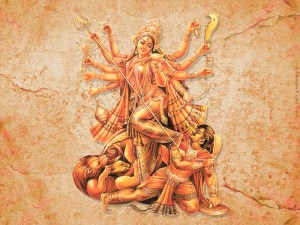
Devi Durga Killing Mahisasura(Picture courtesy : google Image search)

Durga means “Invincible”. She is a fierce Hindu Godess seen riding a Lion which symbolizes as alluding the aspect of courage and valor. She gives courage and strength to her devotees and destroys all the negative forces with in us. In her presence, the negative forces can not exists. Especially in the case of people suffering from anxiety, doubting oneself, doubting one’s ability, ‘lack’ consciousness, feeling threatened by enmity and negativity – simply by chanting the names of the Devis, it is like mantras that elevate your consciousness and you can become more centered, courageous and composed. This is the significance of the aspect of the Divine as Devi Durga.

Devi Durga is mostly seen killing a demon by the name Mahisasura. Mahisasura means the “Buffalo demon”.  Buffalo is a symbol of laziness, lethargy or inertia. Devi Durga gives us the strength and energy to destroy the laziness in us.

Lakshmi
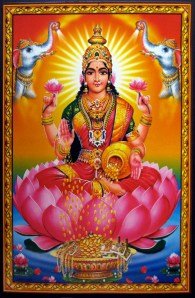
Godess Lakshmi

The second set of three days is for worshipping the Devi in the form of Lakshmi. Wealth is a vital ingredient bestowed upon us for the maintenance and progress in our life. It is much more than just having money. It means abundance in knowledge, skills and talents. Lakshmi is the energy that manifests as the complete spiritual and material well-being of a person. She is the consort of Lord Vishnu. She is said to bring in good luck and protect her devotees from all kind of miseries and finance related sorrows.

Lakshmi is depicted as a beautiful woman of golden complexion, with four hands, sitting or standing on a full-bloomed lotus and holding a lotus bud, which stands for beauty, purity and fertility. Her four hands represent the four ends of human life: dharma or righteousness, “kama” or desires, “artha” or wealth, and “moksha” or liberation from the cycle of birth and death.

Cascades of gold coins are seen flowing from her hands, suggesting that those who worship her gain wealth. She always wears gold embroidered red clothes. Red symbolizes activity and the golden lining indicates prosperity. Lakshmi is the active energy of Vishnu, and also appears as Lakshmi-Narayan – Lakshmi accompanying Vishnu.

Saraswati
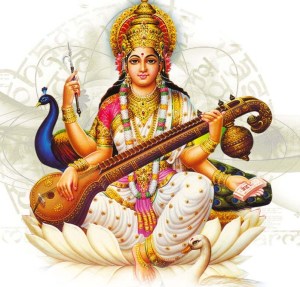
Godess Saraswati

The final three days are dedicated to Saraswati. Saraswati is the goddess of knowledge- the one who gives the essence(sara) of the Self (swa). The name also means Saras – flow and wati – one who has got the flow. She is often depicted as being seated on a rock. Knowledge, like a rock, is a steadfast support. It stays with us at all times. She plays the veena, a musical instrument whose mellifluous notes bring harmony and peace to the mind. Similarly, spiritual knowledge brings relaxation and celebration into ones’ life.

Goddess Saraswati is the ocean of understanding and the consciousness which vibrates with different types of learning. She is the source of spiritual light, remover of all ignorance and the source of knowledge. Saraswati is strongly associated with flowing water in her role as a goddess of knowledge. She is depicted as a beautiful woman to embody the concept of knowledge as supremely alluring. She possesses four arms, and is usually shown wearing a spotless white saree and seated on a white lotus or riding a white swan.

Yagya during Navratri

Sri Sri Ravi Shankar during Navaratri yagya

When many people get together and do something collectively, that is called ‘yagya‘ or ‘yagna‘. There are many types of ‘yagya’.

  • 1. ‘Dravya Yagya’- In which a lot of substances are used. 108 types of different herbs, fruits etc are used.
  • 2. ‘Gyaan Yagya’ – Discussing the knowledge.
  • 3. ‘Japa Yagya’- Singing and chanting of mantras.

These bring purity, prosperity, peace and harmony to all. The whole environment becomes lively. There are three types of miseries: one from outside world, other one from deep inside you, due to karma and the third one is due to the subtle mind. So Navratri is that which gives you rest from all three types of miseries. Mind works in action. When you sleep, what happens? You get relief from the world, relief from the mind, and relief from everything. That is why Navratri is called, the nine nights of complete self-referral activity. Tenth day of the ‘yagya‘ is the Victory Day, also known as ‘Dussera’.

The navaratri for 2012 starts this October 16th and goes on for the next 9 days. During these 9 days, Tte seeker gets back to the true Source through fasting, prayer, silence and meditation. Night is also called ratri because it brings rejuvenation. It gives relief at the three levels of our existence – physical, subtle and causal. While fasting detoxifies the body, silence purifies the speech and brings rest to the chattering mind, and meditation takes one deep into one’s own being.

Let us all have an intention this navaratri to do good to all the people around us!

Jai Maa Durga! (Victory to the Divine Mother)
Share this:

  • Click to share on X (Opens in new window) X
  • Click to share on Facebook (Opens in new window) Facebook
  • Click to share on Pinterest (Opens in new window) Pinterest
  • Click to email a link to a friend (Opens in new window) Email
Like Loading...

Love & Lust

02 Tuesday Oct 2012

Posted by Aravind Venkatachalam in Knowledge

≈ Leave a comment

Tags

Knowledge, Love, Lust, Shiva, Sri Sri

In love even an object gains life. Stones speak to you, trees speak to you, the sun, the moon and the whole creation becomes alive, Divine. In lust even a living being becomes a mere object. You want to use even people like objects. Here are some salient attributes of love and lust. They are so different yet so close! If you find more you may add to the list.

              LUST                         vs                         LOVE

Lust bring tension Love brings relaxation
Lust focuses on the part Love focuses on the whole
Lust brings violence Love brings sacrifice
In lust you want to grab and possess In love you want to give and surrender
Lust says all I want you to have is what I want Love says I want you to have what you want
In lust there is effort Love is effortless
Lust causes feverishness and frustration Love causes longing and pain
Lust imprisons and destroys Love liberates and sets you free
Lust demands Love commands
Lust gets you mixed up and confused In love you are focused and spaced out!!
Lust is only dark and monotonous Love has many modes and colours

If someone’s lust is interrupted they get angry and start hating. Hatred in the world today is not out of love, it is out of lust.

Love is playfulness and in lust there is cunningness and manipulation. Shiva, the embodiment of innocence and love was meditating. His meditation was disturbed by an arrow of flowers from the lord of lust. As soon as Shiva woke up he opened his third eye and the lord of lust, Manmatha (one who churns the mind) was reduced to ashes. Everybody celebrated by throwing colors on each other realising that life is full of colours.

We play many roles in our life. If all the roles get mixed up it becomes dark, like when you mix all the colours. The wise play each role distinctively side by side, like colors displayed side by side form a rainbow.

– Sri Sri Ravi Shankar

Share this:

  • Click to share on X (Opens in new window) X
  • Click to share on Facebook (Opens in new window) Facebook
  • Click to share on Pinterest (Opens in new window) Pinterest
  • Click to email a link to a friend (Opens in new window) Email
Like Loading...
Newer posts →

Days to WCF

World Culture FestivalMarch 11, 2016
The World Culture Festival in New Delhi, INDIA!

Categories

  • Art Of Living
  • General
  • Inspirational Quotes
  • Katha Vidya
  • Knowledge
  • Poems
  • Stories
  • Videos

Pages

  • About Me
  • Guinness Records
  • Sri Sri Ravi Shankar

Art of Living Ashram Bad habits Bhagavad Gita Brain Breath Campaign Choice community Death Dushyant Ego emotions Guru Guruji Happiness health Inspiration Karma Knowledge Life Love Mahabharata Mahabharatha marriage Meditation Mind Navaratri Peace Poem Poetry Prana Pranayama Quote Quotes Relationship Satsang Society Spirituality Sri Sri Sri Sri Ravi Shankar Story Stress Stress Free Sudarshan Kriya Teacher Video games Violence Violence Free Yoga

Enter your email address to follow this blog and receive notifications of new posts by email.

Join 1,118 other subscribers
Follow Art of Living, Sri Sri Ravi Shankar and My Self! on WordPress.com

My favorites

  • Flying High in Peace
  • Kaalakshepam...
  • Art of Living Blog
  • Intenseice
  • Life is an Art, You are the Artist

Blog Stats

  • 141,781 hits

RSS Feed RSS - Posts

RSS Feed RSS - Comments

January 2026
M T W T F S S
 1234
567891011
12131415161718
19202122232425
262728293031  
« Sep    

Prayer

Saha nav avatu, Saha nau bhunaktu, Saha viryam karavavahi: Tejasvi nav adhitam astu: ma vidvisavahai; Aum Santih, Santih, Santih - May He protect us both; may He be pleased with us both; may we work together with vigor; may our study make us illumined; may there be no dislike between us. Aum, peace, peace, peace.

Recent Posts

  • World Culture Festival 2023
  • Pain remains until another Pain comes along
  • Mantras
  • Critic or Profiteering – For Anti WCF Brigade – Part 1
  • 33000 artists to perform in WCF!

Archives

  • September 2023
  • July 2023
  • May 2022
  • February 2016
  • July 2015
  • May 2015
  • July 2014
  • June 2014
  • May 2014
  • April 2014
  • March 2014
  • February 2014
  • July 2013
  • April 2013
  • March 2013
  • February 2013
  • January 2013
  • December 2012
  • November 2012
  • October 2012
  • September 2012

Aravind Venkatachalam

is a senior software engineer living in the Bay area. He is a devotee of Sri Sri Ravi Shankar and volunteers for the Art of Living Foundation. He uses this blog to share his ideas on ancient wisdom from the Puranas and from Sri Sri along with many other stories and juicy stuff!!

Create a free website or blog at WordPress.com.

Flying High in Peace

Kaalakshepam...

Stories untold and retold

Art of Living Blog

Intenseice

Life is an Art, You are the Artist

Privacy & Cookies: This site uses cookies. By continuing to use this website, you agree to their use.
To find out more, including how to control cookies, see here: Cookie Policy
  • Subscribe Subscribed
    • Art of Living, Sri Sri Ravi Shankar and My Self!
    • Join 121 other subscribers
    • Already have a WordPress.com account? Log in now.
    • Art of Living, Sri Sri Ravi Shankar and My Self!
    • Subscribe Subscribed
    • Sign up
    • Log in
    • Report this content
    • View site in Reader
    • Manage subscriptions
    • Collapse this bar
 

Loading Comments...
 

    %d